Quotes

Life is short, break the rules. Forgive quickly, kiss slowly. Love truly, laugh uncontrollably and never regret anything that makes you smile. - Samuel Longhorne Clemens (Mark Twain)
Showing posts with label Painting HO Scale. Show all posts

Thursday, January 18, 2024

Painting the HO ScaleHumans - Skintones

I went back to try and find the ScaleHumans on Shapeways because I forgot to bookmark it. Shapeways drives me crazy. ScaleHumans is the name of sculptor's shop on Shapeways. That's the easiest way to get to his stuff (Shops/scalehumans). If you are trying to look for him as the designer you need his name, not the shop. The sculptor is Richard Kapuaala (designer/rkapuaala) and that gets you to his bio on Shapeways and you can get to his shop from there as well.

Back to the painting. I finished up the fleshtones on these. I, of course, went a bit to wide with my last skin tone and had to dial it back with a glaze of my dark skintone (Burnt Red Brown, A.MIG-0134). Then it was back to the main highlight (applied a bit more carefully this time) and followed that with one more higher just to emphasis some of the facial features.

The facial details on these is a bit better than the ones from Modelu. That little bit of exaggeration by the sculptor goes a long way to be able to make the details pop.

Skintones:

Burnt Red Brown - A.MIG-0134

Red Leather - A.MIG-0133 

Burnt Sand - A.MIG-0118


Friday, January 12, 2024

Painting the HO ScaleHumans - Detail Wash

After some relatively intensive training over the last week and a half I have finally found my way back to the workbench.

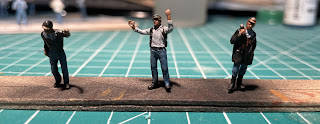
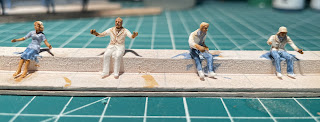
I'm back to the HO scale group from ScaleHumans on Shapeways. I only had time to do the basic wash to bring out the details on these. This really made the detail pop, but it also emphasized the printing lines on them as well. You can definitely see the difference between the Tan Fine Detail plastic and the Clear Ultra Fine Detail plastic. When I order again I'm definitely going with the Clear Ultra Fine.

Like with previous work this initial thin wash is done with Reaper Miniatures' Brown Liner. Because I do two thin washes I use Vallejo Airbrush thinner to thin it out instead of water.

These seated engineers are all printed in Ultra
.
Pretty sure this one is in tan

These three are all done in tan plastic

This is a mix. The two on the left are in tan the two on the right are in ultra


Tuesday, January 2, 2024

Painting the HO ScaleHumans - Priming

The Holidays are over and I finally have some time to get back to the workbench. I'm going to start the year off working on the HO scale prints from ScaleHumans (available on Shapeways). I had prepped both the HO and O scale versions a couple of weeks ago so its time to get down to business with a little primer.

Once more to the airbrush booth with Badger Stynylrez grey primer. Nothing special here, thinned the primer a little bit set the psi to 10.

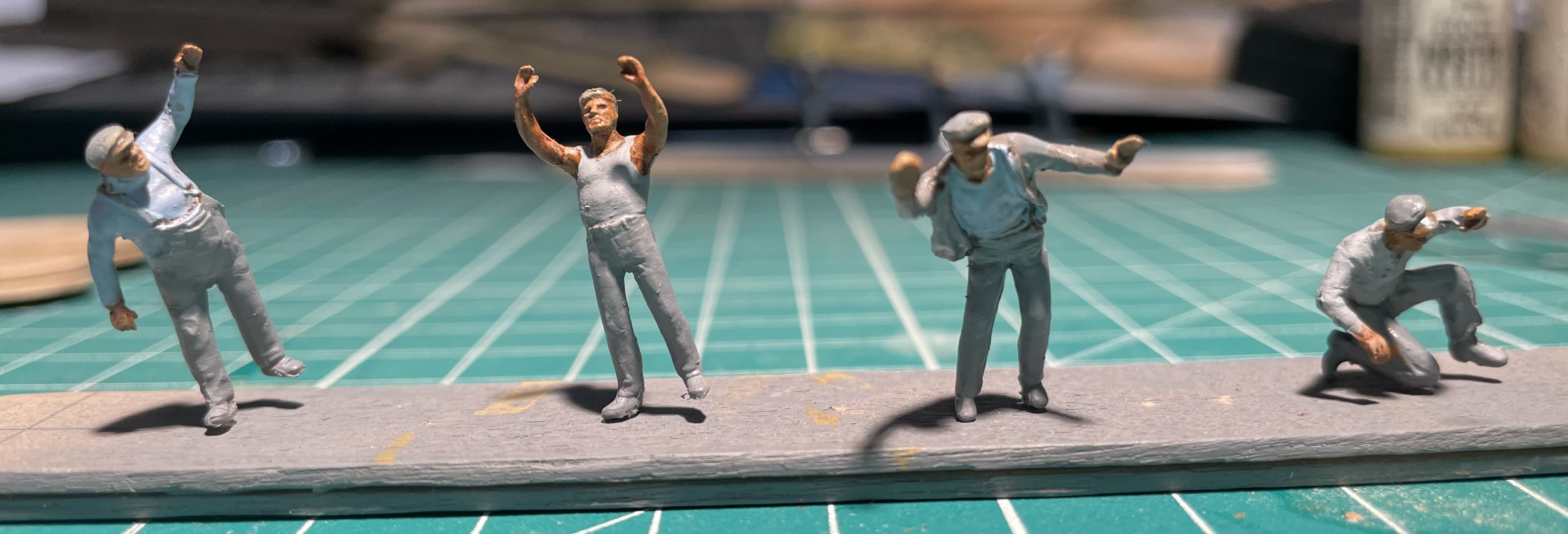
Here are the results:
They look pretty good at this stage, but I am concerned about what look like printing artifacts/rough patches and a general fuzziness to some of the prints. I'm going to go ahead and get some paint on these and see how they look after that first wash. Otherwise I may be experimenting to see how I can finish them better for painting. I had selected a tan for one set (which I shouldn't have been able to) and ultra for the other set. They are easy to tell apart, the ultra ones are visibly smaller and I don't know if that's because of the material they are printed in. The only way to know for sure would be to order the other set in ultra and see what happens.


I love this conductor. Unfortunately I won't be able to use him on the Warehouse Row layout, wrong era. Everyone else is generic enough to pass for the late 50s without a problem.


Thursday, February 23, 2023

Painting HO Scale Miniatures - Step 6 - Almost There

Well, I was hoping to be done with these, but they aren't quite ready yet. The few extra details have been painted up; hats, hair, gloves and what not. In addition to that I have added some lining but I'm not completely finished with that step, however, its been a while and I wanted to show the progress.

My issue with them now, as we reach these final steps, is the skin has ended up being to dark on most of them. So my next step will be to finish up the lining, pick out any details I missed and then go back with the bronze skin mid tone (or perhaps something else) and lighten up the skin.

Overall I'm fairly please with how these came out. I think the are significantly better than what you typically see on most model railroads. Overall I figure I have spent about 2 hours of painting on these 30 miniatures. Its hard to calculate the prep time but place that at an hour which means I'm spending roughly about 6 minutes per miniature. I got there by painting in mass (something wargamers are quite familiar with). Pick the number of miniatures you are comfortable with and prep and paint them all at once. I do admit that I basically skipped the two guys in suits though. You can a lot of time by keeping your color palette small and moving from one figure to the next with that color. You lose time by constantly changing colors as you move from one figure to the next.

I'm going to purchase some better sculpted HO folks and see what I can do with something that is well sculpted and produced using these same basic techniques. And in regards to these Preiser miniatures apparently steering wheels are huge on German vehicles? All the ones that have arms set like they are holding a steering wheel look like they are driving an 18 wheeler.

Group 1 Black Primer

Group 2 White Primer

Group 3 Grey Primer

Group 4 Zenithal

Group 1 Black Primer

Group 2 White Primer

Group 3 Grey Primer

Group 4 Zenithal


Saturday, February 18, 2023

A Brick Building from the Ground Up - Part 1

I actually started testing the brick painting on a piece of brick wall from ITLA Scale Models. I have had one of their kits plus a couple of modules for it laying around for a number of years now. It was another one of my purchases for a layout that will not come to pass at this point so its a "spare". That being said it will have a purpose as a backdrop building for photography, same as the brick store.

Here are the two pieces that I experimented with colors on before moving on the brick store. The one on the right also has a coating of Pan Pastel Raw Sienna on it, the one on the left doesn't

I had already primed this building with a grey primer, specifically Badgers' Stynylrez grey. ITLA are laser cut wood models so you definitely need a primer of some kind on this for the ink techniques to work. If the surface isn't primer or at least sealed it really sucks up the ink. That wood is thirsty!

Step 1
I coated all the pieces with Titanium White from the Liquitex Acrylic Ink line (well, except the two pieces that were essentially finished). I wasn't going for particularly even coats of color, just wanted to be sure there was white in the mortar lines (I did add a drop or so of raw sienna to this mix, mostly to get a more off white color). Let it dry, longer than you think, its possible to "re-activate" ink if its not completely dry for the next step.

An example of the white ink just basically being smeared across everything. I have decided to paint the sidewalk separately from the rest I want to try an oil technique on it.

Step 2
With a "dry" brush of Raw Sienna ink dragged it across the surface after the white had dried surface. You don't want a full brush full of ink, if its really wet you can potentially re-activate the ink underneath and you are trying to stay out of the mortar lines. You are going to get some in the mortar lines (maybe even most of the mortar lines) and that's okay. Cover 90 - 100% of the surface at this point. Let it dry, but not crucial for the next step. Yes, I forgot to take pictures.

Step 3
Here we are going to repeat the process with the raw umber this will give us some darker areas, and if the first layer isn't completely dry then it will just blend together. I aimed for about 50% of the total surface are, but its up to you.


Looks a little rough now, but I think everything will tie together as I go along, much like it did with the brick store.


This finishes, the painting part of the operation. Pretty quick, relatively easy and gives a good initial look to the brick surface with mortar lines showing all the way through in some areas, which is what you would expect for an older brick building.

After all this I painted the rough stone at the bottom and the concrete bands. The rough stone received a similar treatment to the brick while the concrete bands just received a quick wash of a grimy black (I didn't right it down, better check to see what I used for this. Again, missed taking pictures, just to much going on.

From here its on to assembly.

Thursday, February 16, 2023

Painting HO Scale Miniatures - Step 5 - Getting to the details

The basic painting has been completed at this point. Now its time to go into the details. Again, I try to continue follow my process of painting from the inside out. Now, I'm going after things like, belts, shoes, jackets, purses and the like. We are closing in on the finish line.

At this point the process is pretty much the same. I have kept the number of colors way down at this point just to try and speed things along a bit. You will probably notice my penchant for green. One of the things I have tried to experiment with a this point is lining. You can think of this as a tightly controlled wash. Instead of paint this time around I tried my Liquitex Acrylic inks, in this case Burnt Umber. 

The idea is to paint a "shadow" at each color junction. So places where skin meets cloth or a piece of clothing meeting another piece of clothing. I realized after I took the pictures that I hadn't really managed to follow through with this on all of the miniatures but you can see the difference on the ones I did. 

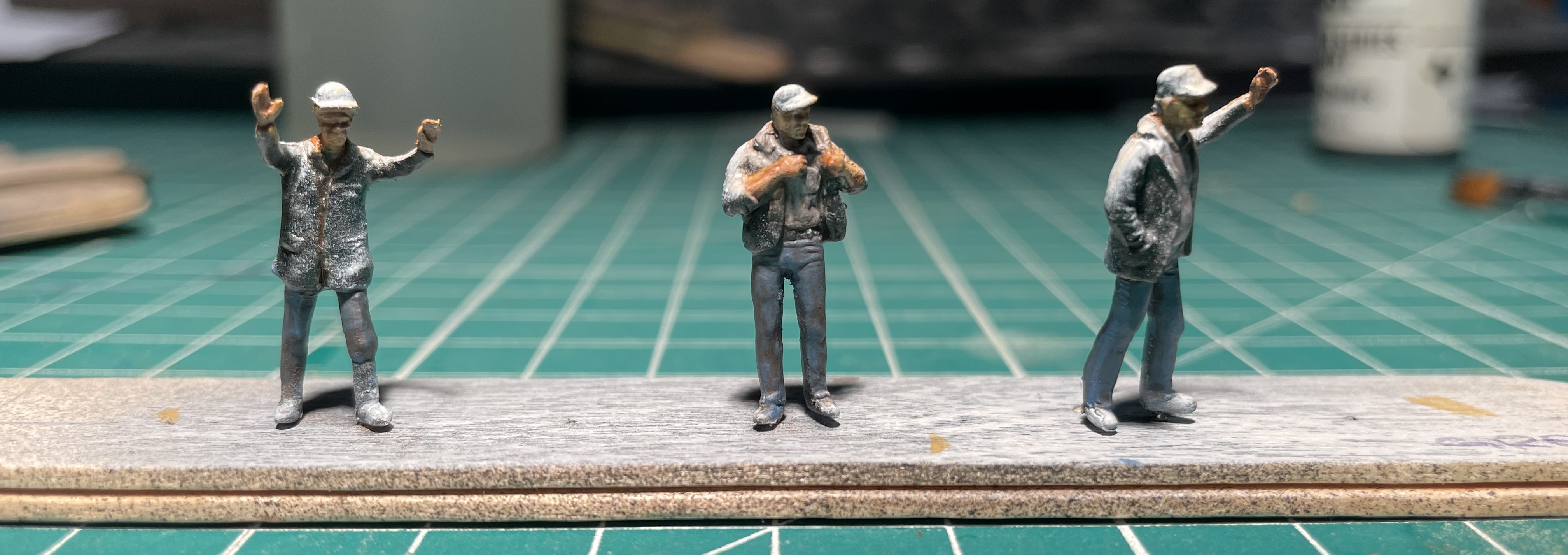
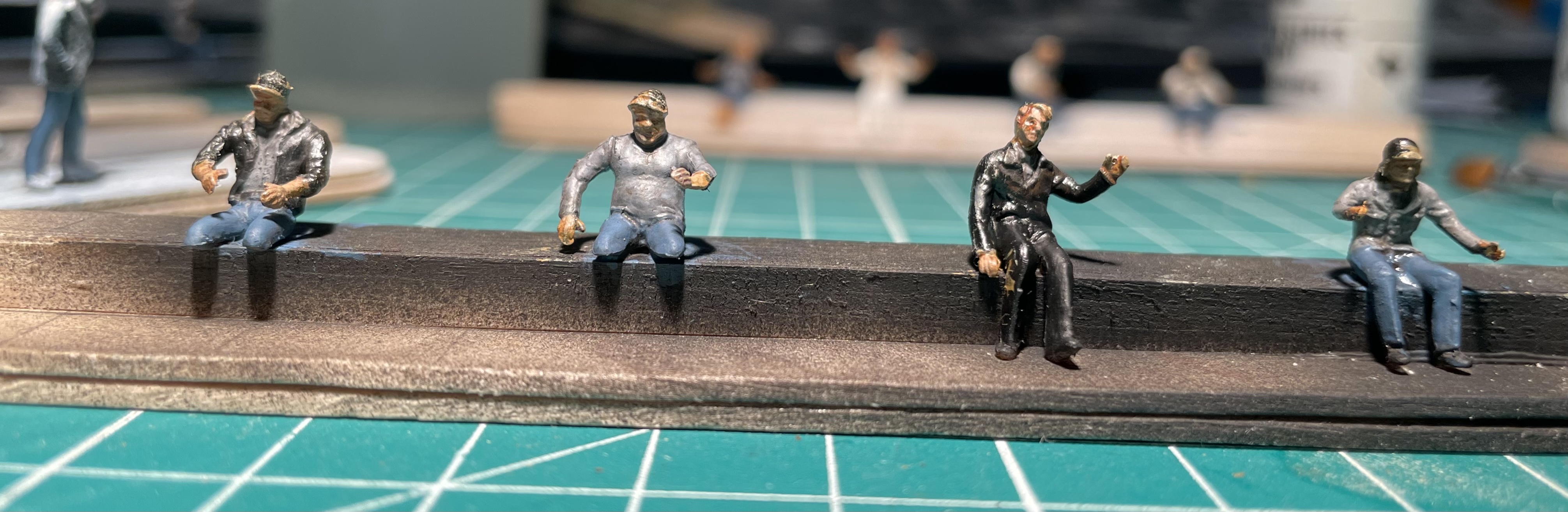
At this stage you can really see how the different primer colors affect the colors you are applying. I'm still leaning towards my favorite of a neutral gray primer, both black, white and the zenithal style have coverage problems, often requiring 2 or more coats of thinned paint to get good coverage. You can also see the color shifts when the neutral grey background is more in the picture and the camera adjusts for the light better, all the standing figures are shifted a bit more towards yellow because of the light.

Group 1 Standing, Black Primer
Group 2 Standing, White Primer

Group 3 Standing, Grey Primer

Group 4 Standing, Zenithal


Group 1 Sitting, Black Primer

Group 2 Sitting, White Primer

Group 3 Sitting, Grey Primer

Group 4 Sitting, White Primer

Things are coming along, its been hard to find the time to paint so this is going slower than I had hoped. I should dig around and see if I can find some more miniatures and do one just in the grey primer in one session and time it.


Thursday, February 2, 2023

Painting HO Scale Miniatures - Step 4 - Basic Painting - Clothes

Before we break out the brushes for another round let me just say that nothing here is set in stone. Take the process and modify it to suit your needs, experiment and don't be afraid that something might not work out as intended. After all its just paint and you can paint right over it, your brush can be an eraser too!

Time to move on to the clothes. Following the guide we are going to hit the pants and shirts (and dresses) next. I am painting this bunch with an eye towards using them on the Warehouse Row layout (when ever that gets built) which will be set in the late '50s early '60s. From a clothing perspective we are looking at an almost uniform like clothing style. Since most of these miniatures are male and some form of laborer I'm going to go with a lot of jeans and light grey, or bluish grey shirts. At the moment that's going to make everyone start to look very similar to one another but that is also part of the process.

When you are batch painting you want to be efficient which means grouping your similar miniatures together, that avoids constantly switching back and forth between different colors. To go along with that we are going to paint all the miniatures that will be using the same color at the same time regardless of where they maybe on my painting sticks. I'm starting off with a blue for pants, overalls, skirts and dresses. Again we will start with the mid tone blue this will, more or less, clothing that has seen some wear and fading. I started with Grp 1 Standing Miniatures and just worked my through in order through all eight groups. I used a smaller chip brush for this to reduce the painting time since we are dealing with relatively large areas. After I finished the blue I went back and just checked them to make sure I had covered all the relevant areas.

I moved on to the shirts (and one blouse). I decided on a light grey (not white) and a very light greyish blue just to get a little variety. I did half of the miniatures in the light grey and half in the greyish blue. At this point I could see a visible difference between the two colors. I used the same brush but found myself using the edge a lot more than the flat tip, which means I could have used one of my workhorse rounds to do this work, especially on the two or three miniatures wearing overalls and trying to avoid painting the straps that were already painted blue. I could have remedied that by painting the shirts first then the pants, nothing like 20/20 hindsight.






Now we need some contrast and that means adding shadows and some highlights, the same basic process. I experimented here a bit, first with a very dark blue as a wash for the blues and a darker bluish grey for the shirts. I applied this some what liberally over all the painted clothing. I made sure that there was a good line of color at anyplace where clothing met skin or a different piece of clothing. In this case mostly in that crease where a shirt met a jacket, but there are plenty of places to accentuate those spots where skin met cloth as well. Make sure your wash isn't pooling and if its sitting on high spots wick it away with a clean brush.

At this point I was not happy with the look after I was done. I decided to go darker and with a single color, black would have been a reasonable choice but I think black is just to harsh so I went with something called Charred Brown, a very dark brown. I repeated the process with this color and I was much happier.


Partially because I had two layers of wash and partially because the last one was very dark I need to restore a that mid tone color a bit. Working with the thought of a "high noon" sun I applied it lightly to the areas most visible and into the shadows a little bit (not the deep shadows that we just spent so much time adding a wash to). I did the same with the shirts but only used the light grey, after the wash the difference between the two colors was virtually invisible.

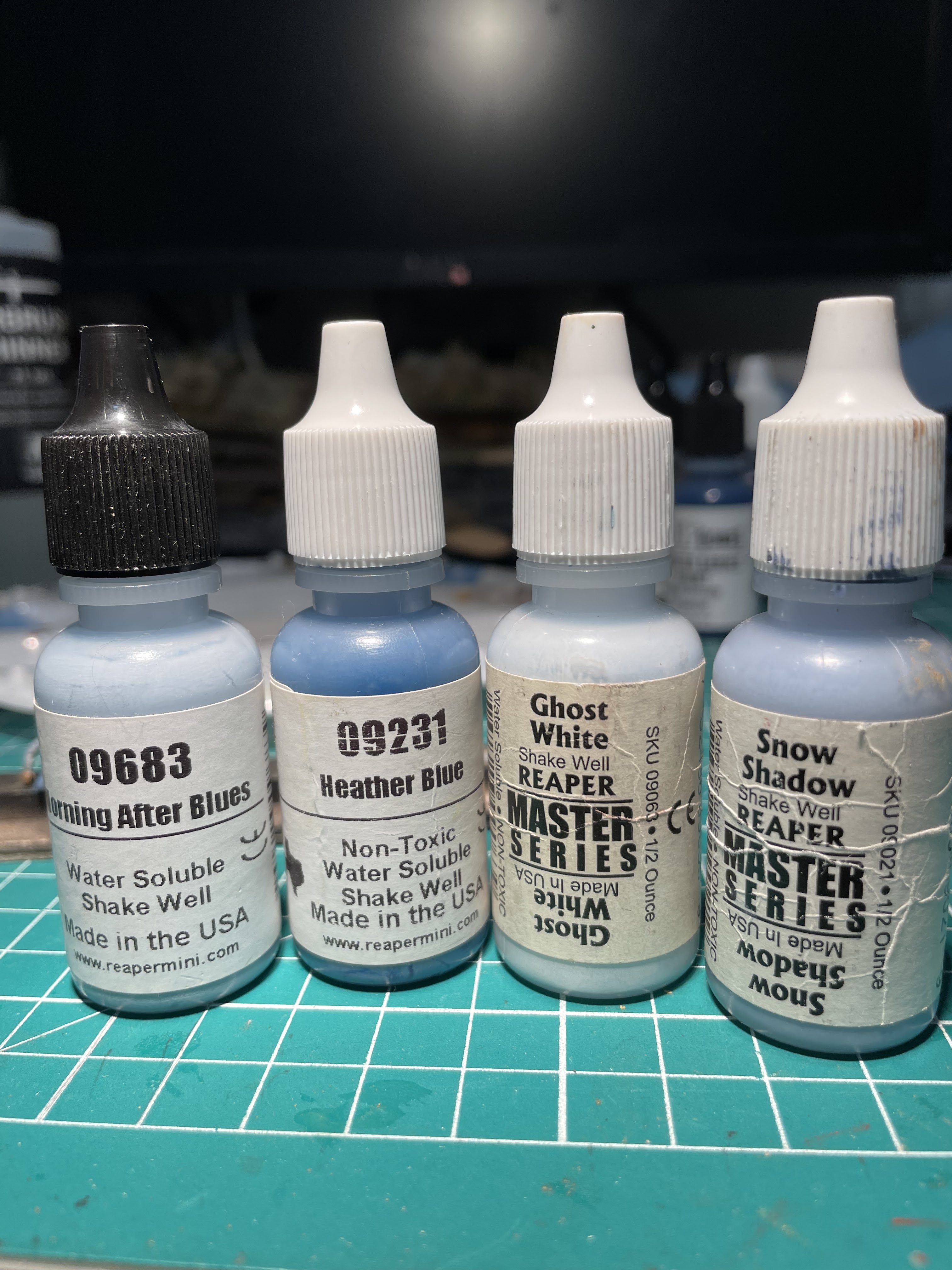
After I cleaned that up I added the highlight. Just like the skin I used a 1:1 mixture of the mid tone with a lighter color, a very light blue for the jeans and very light grey for the shirts. I used a workhorse round brush for this and instead of the tip I use the edge. A "wet" drybrush technique dragging straight down where appropriate or highlighting a top of edge of the cloth (mostly on the seated miniatures.)


At this point I'm pretty pleased with the look and I don't feel like I have spent an inordinate amount of time on these. Its always hard to tell how long it takes. My sessions tend to be pretty short and somewhat infrequent during the week.