Quotes

Life is short, break the rules. Forgive quickly, kiss slowly. Love truly, laugh uncontrollably and never regret anything that makes you smile. - Samuel Longhorne Clemens (Mark Twain)
Showing posts with label D&RGW. Show all posts

Thursday, December 22, 2022

Returning to Denver's Warehouse Row - Another Look

Our thoughts have turned to what room we will be renovating next. I'm pushing for the "library" room, a small bedroom that has a bunch of bookshelves plus our large craft cabinet in it. This would involve getting rid of the existing bookshelves (or at least moving them somewhere else in the house) and then painting the walls and probably the ceiling. Once that's done then we can start putting up new shelving.

There are couple of requirements for the renovation. First it has to provide some desk space, probably under the window. This is important as we both work at home now and while we prefer to be in the same room, however, when we are both on conference calls one of us has to move. Right now I'm moving into my workshop room in the basement which means I'm constantly putting away model projects because I need the desk space. Which further delays my model projects! 

Second is to replace the bookcases with bookshelves. What do I mean by that? We need something that's more flexible than a standard bookcase. My intent is to line the walls with french cleats which will allow let us arrange the shelves as we need. While we would still be restricted by the location of the cleats we would not be restricted by height (other than the ceiling) or the width of a bookcase. In turn this would allow me to use the cleats to attach a layout to (the secret reason for using french cleats) directly to the walls without a lot of extra effort.

The third requirement is non-negotiable at this time, the craft cabinet must stay. While it is fairly compact when closed when fully open it occupies a 7' width. However, it would be closed the majority of the time and it doesn't have to be fully opened to use. I will capitalize on that aspect. Since the cabinet doesn't have to be tied to the wall I can leave a gap behind it to provide a limited amount of staging which would, again, be suspended on french cleats to a spot behind the door where cassettes for staging would reside. This would keep these hidden except when the layout is in operation.

I have been studying Warehouse Row on Wynkoop street for sometime now. Recently I asked a question on the D&RGW forum about what local or job switched Wynkoop street. A fair amount of information tumbled out (and may result in an article for "The Prospector" the Rio Grande Modeling and Historical Society's quarterly publication) in a fairly active discussion. 

This is the discussion that unearthed a photo that showed a diamond crossing directly under the 15th street viaduct on the east side. This crossing doesn't show up on any Sanborn map that I have access to and it would be crucial to switching the area efficiently. In fact I had added such a crossing on the last plan that I had drawn but centered between 15th and 16th street.

Photograph by John Hill. A picture that I had not seen before. Its sometime after the 15th Street viaduct was put in and you can see some interesting trackwork right underneath it. This is the kind of information that can be found when you ask a question in the right forum!

I have been dithering about the year and I think it will be 1958. This would be before the postal annex was built so the long siding serving those businesses would be present and it would have been possible for the 15th street viaduct to have been built (based on when it was first proposed, I think it was actually constructed in the early 60s). I'll have to decide if a couple of the businesses will be back dated to earlier occupants or not. 

The amount of space available for the main section of the layout is 13' 9". I was messing around with scales and I think I can almost fit the entire area between the Speer Viaduct (across Cherry Creek) all the way down to 16th Street with very little compression needed. I have been doodling around with that concept for the past week or so. The problem I'm running into is the arc of the curve needed to move trains in and out of the staging area. So nothing final by any means but I think I'm getting closer. Close enough that I have a bought a some freight cars off of eBay (great deal on that one) and I'm looking for some motive power. The 1958 period allows a lot of leeway there; Alco RS3, Alco S2, Baldwin VO660, Fairbanks-Morse H10-44 and H15-44. I don't know exactly what was used in the area but all of those are available, on way or another, in HO scale. I do know that these area was handled by the 7th Street Yard and I think in that long discussion it was determined that it was probably not a specific job just handled by the yard crews probably at night or early in the morning. Still information to uncover.

Picture is a little small, but this map is pieced together from three different Sanborn maps. If you slide the map further to the left the edge of the 16th Street Viaduct just goes over the edge of the space. Without doing to much measuring I think I don't need to lose more than a couple of inches to get the whole 16th Street Viaduct on the layout. This makes for a great LDE that fills the space without any major constraints to deal with.


Tuesday, December 13, 2022

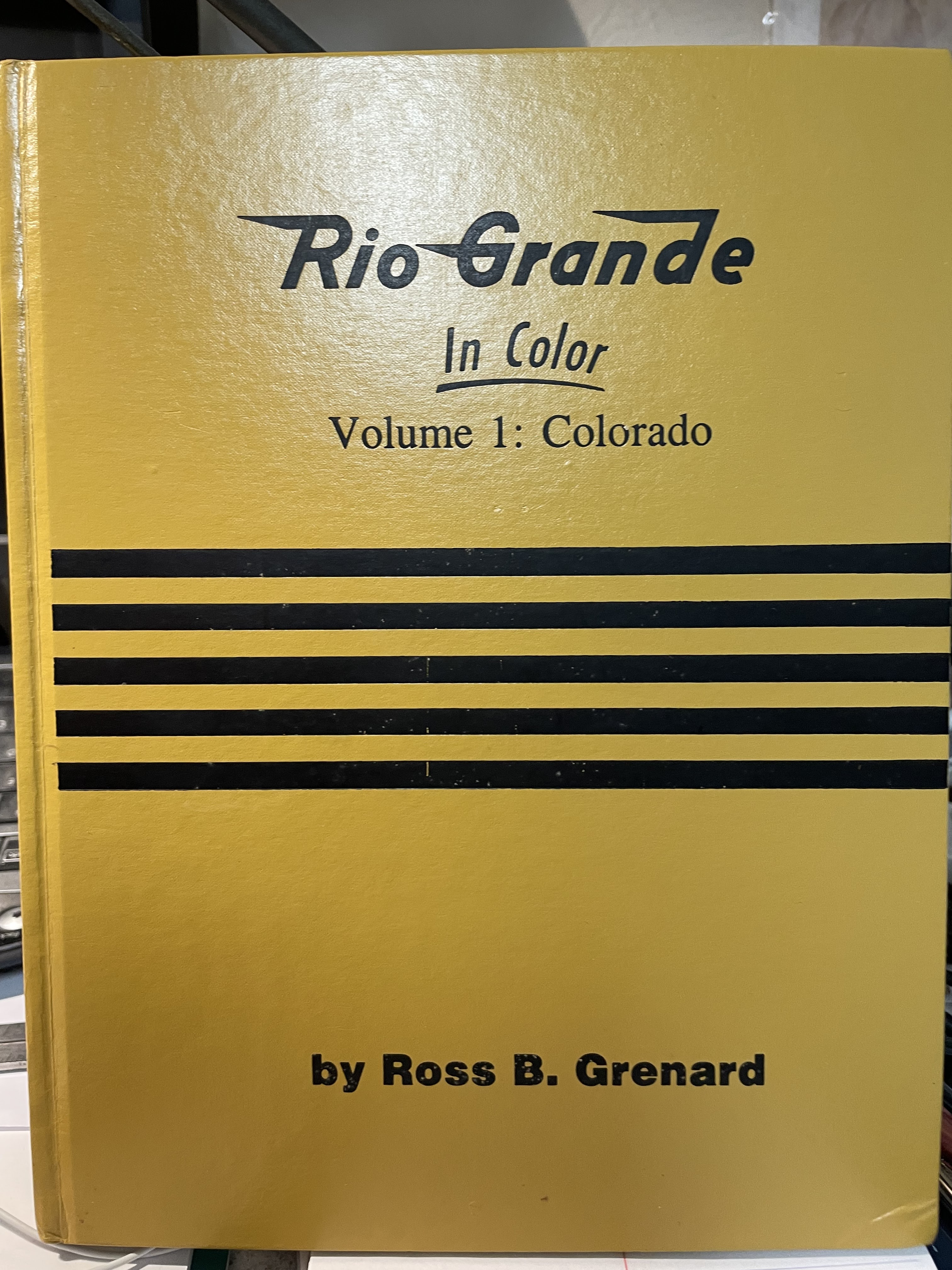
Acquisitions - Railroad Book (another one); Rio Grande in Color Vol 1: Colorado

I continue to build up my collection of D&RGW reference books. This one is out of print and missing the dust jacket but the price was pretty good compared to what I have been seeing so far. This one was written by Ross Grenard and it is a 1st printing.

I have thumbed through is a little bit and the pictures are great and its pretty much confirmed that I could use Alco RS3s to switch the Warehouse district. There are other options as well, but I think I'll concentrate on trying to acquire and RS3 in Rio Grande colors.


Tuesday, October 11, 2022

Acquisition - Accurail - D&RGW 40' DBL DR AAR Boxcars

This is my first acquisition of D&RGW rolling stock for the Warehouse Row layout. Granted construction of said layout is still a long way out but it was a good deal. I like Accurail kits and this was a set of three 40' Boxcars in one of their 3 box series, so you know the car numbers will be different. 

I was looking forward to putting these together, but I didn't read the listing close enough and these are already built. Nicely built I might add, the only thing I need to do is through on some better trucks and do some weathering and these will be ready to go. I was pleasantly surprised with the quality of the build so the $15 I spent on each one was money well spent!


Friday, August 26, 2022

Warehouse Row - The Wynkoop Street Bridge

There is a picture from the Cornell University Library in the US Railroad Commission photographs that shows a very busy section of Wynkoop Street where it crosses Cherry Creek on a skewed Pratt through Truss bridge that figured prominently in my decision to shift which railroad I was modeling and what location to use.


This is the photo, the original is black and white, I was trying out some colorizing software and there are a few odd color selections being made by the software (check the blue section in between the trusses at the end). I'm not sure exactly when the photo was taken but it can't be any later than 1960.


And here is the original

From a slightly different angle


This particular picture is what convinced me to shift from modeling the "Patch" district in LA to Warehouse row in Denver. Now admittedly I'm still clutching at a few straws around actual operations but I have the general area figured out pretty good, or at least I thought I did. I was in a D&RGW discussion group and it was noted that the bridge, apparently, doesn't show up on the listing of D&RGW steel bridges (I suppose I need to try and verify that).

Which also brought up the fact that crossing the bridge to the south actually takes you directly into the C&S' Rice Yard, although you can get to the D&RGW 7th street yard. So which railroad actually switched the area and who owned the bridge? And just to confuse the issue on an old Sanborn Map (1903) the trackage is listed as D&RG/UP trackage, so maybe the UP owns the bridge, although their yards were to the north so probably not. Yet another little mystery. I might have come full circle and need to model the C&S in the '50s and '60s.

Thanks to a couple of websites I at least know who built the bridge; The Pennsylvania Steel Company and it was built in 1907 (which is after the date on the Sanborn map, not really relevant except that this one must have replaced an iron bridge that existed previously since Sanborn indicates it is an iron bridge in 1903).

Photo by Bob Morgan 2/2009

Photo by Bob Morgan 2/2009


Thursday, April 7, 2022

Railroad Research - New Book - A Century + Ten of D&RGW Narrow Gauge

This is a weighty tome, everything you ever wanted to know about D&RGW narrow gauge freight cars! This is a second edition of Robert E Sloan's "A Century + Ten of D&RGW Narrow Gauge Freight Cars, 1871 to 1981", published in 2008. The first edition was published in 2000 but the 2nd edition has been expanded and the photographs and drawings were improved/enhanced.. I have seen this book going for almost double the retail price, but I decided to visit the publisher's website (BHI Publications) and they still have it in stock for $80, still expensive but better new at $80 than used at $160!

Just broadening my knowledge of the D&RGW narrow gauge empire With visions of designing the layout of the C&N, I figured that I should have a few D&RG visitors on the layout. There are a few photos in the "Switzerland Trail of America" by Forrest Crossen showing foreign freight cars on the C&N and that's all the excuse I need. With the new project in flight I'm really mostly interested in the cabooses; chapter 8, pages 191-256, that's a lot of information about cabooses. Pretty much a must have reference book for devotees of the early days of the D&RG (before the W). The one feature that makes this a great book for modelers is the spiral binding, every page can lay flat for scanning or photocopying when using a plan from the book.

Here is my, soon to become dog eared, copy.


Wednesday, January 8, 2020

Acquisition - 78-79 Ford Bronco in 1/87th scale

I continue to peruse through Lance Mindheim's new book and because of that I have been looking at cars and trucks in HO Scale. Lance recommends getting the best quality vehicles that you can because of their visual impact, although he also says you should avoid using people because of like of quality. I can't say I disagree with that but unfortunately these two things go together. On top of that finding enough different cars for the time period isn't easy either. I finally resorted to Shapeways and found a designer that goes by madaboutcars. He is not kidding, he has over 1000 offerings of mostly cars on the site. I decided to get one to check the quality. Since solid cars are just going to look strange I opted for one of his interior/exterior models which are pricey to say the least. I ordered a 78-79 Ford Bronco without thinking about it being way outside my time period but I doubt the average train enthusiast is going to notice that little fact.

I'm really pleased with the quality of the casting from Shapeways, there are a couple of rough spots, especially down the driver's side of the truck but nothing that can't be dealt with. I'll have to figure out a way to add windows (I think there is a product out there for that used by aircraft modelers) and I think these will work really well. At least I can add a driver and passengers without a problem.


Tuesday, April 5, 2016

A Real Puzzler!

My mother and sister-in-law introduced me to a new line of lasercut wooden puzzles that are produced in Boulder, CO. My family has been into puzzles for as long as I can remember and working on a puzzle was always a big family activity. These puzzles have really caught my eye and they have an option to do custom puzzles!

Liberty Puzzles

While I'm not sure if I will pull the trigger I'm giving it some real hard thought right now. With that in mind I have pulled some of my railroad photographs together for consideration as a potential puzzle. They feature my favorite steam engine #30 of the Colorado and Northwestern, several of the Galloping Goose incarnations from the Rio Grande Southern and engine #318 from the D&RGW. All of the photos will need some editing before I pick one but if you have a favorite let me know!

Colorado & Northwestern #30 (also worked for the C&S and RGS)

Galloping Goose #2

Galloping Goose #5

Galloping Goose #6

Galloping Goose #7 on the turntable

Galloping Goose #7 at the bend

D&RGW #318

Friday, August 29, 2014

Freight Cars for Calamity - Step by Step Weathering - Wrapping it Up

Up to this point all the previous steps have really just been prep to get to the fun part. Especially in the case of the gondola since I had to cut apart my decals to get them to fit between the stake pockets. The reality is that the weathering process itself doesn't take very long, it gets stretched out trying to take pictures (or remembering to take pictures).

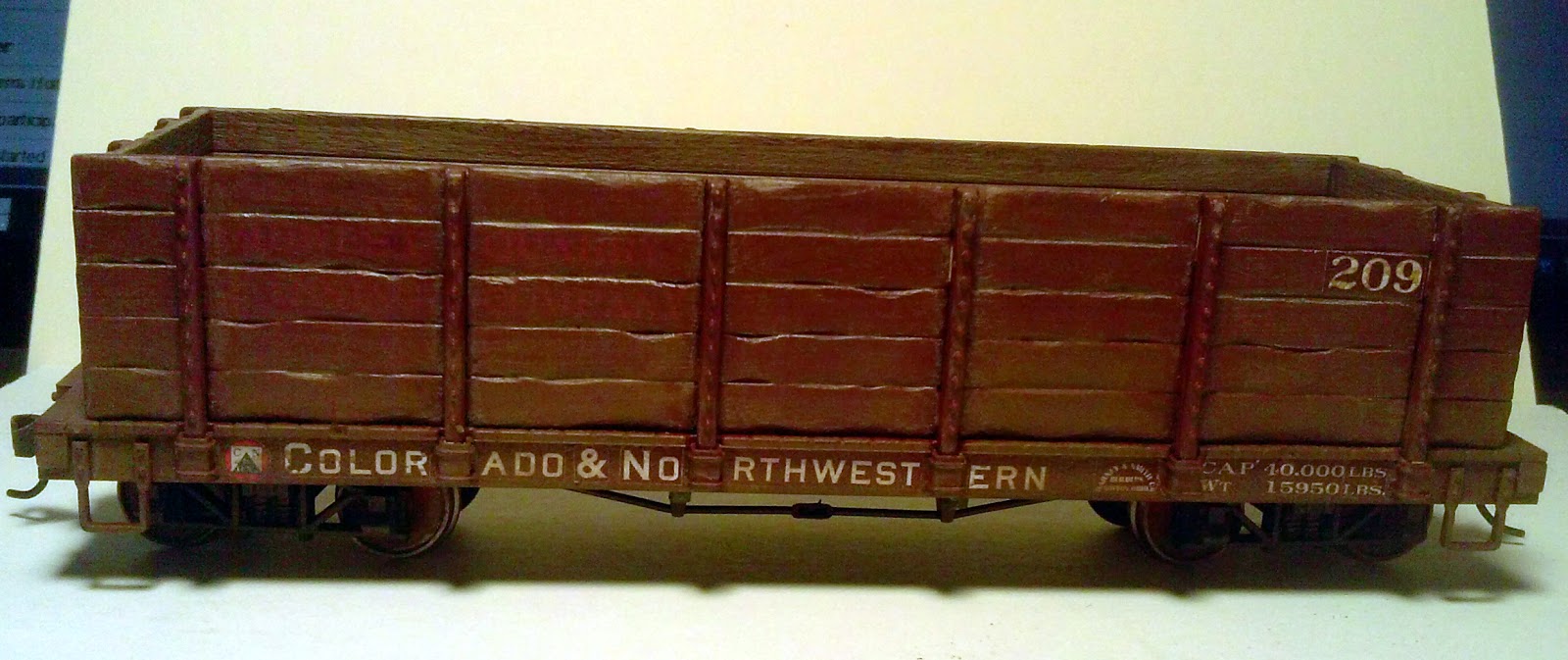
The next step for the gondola is to get some paint on the boards on the interior sides and floor. What I want to do here is show paint worn away by heavy use. The normal load for these gondolas was probably coal since the C&N had its own fleet of drop bottom hoppers for ore. However, I'm sure that they were pressed into service to carry various ores as needed. Boulder County is mostly mined for gold ore and tungsten although there were silver mines as well but none that were actually served by the railroad. I drybrushed some of the upper edges of the outside with a greyish brown paint and gave a heavy coating on the inside, leaving more of the original red in the corners and edges where the sides come together with the floor.


I then followed up with a burnt umber wash made from Liquitex Ink and distilled water. Colorado water is a little on the hard side and I try to keep the minerals out of my paints as much as I can by using distilled water.


Now all of that ink needs to dry before I can start applying pigments to it. Otherwise you can create quite a mess when dry pigment meets wet ink. Its not pretty, but it can be cleaned up when it happens.
With the gondola drying its time to turn to the boxcar. I want to try a different technique on this one involving Isopropyl Alcohol (rubbing alcohol you can get it at the grocery store or your local drugstore. I buy the 99% pure stuff) and dry pigments. I'll create a wash with this and see how that goes. Remember weathering is all about experimenting and thinking outside the lines a bit. Although its probably smarter to try something new on a cheap test car first!

For this one I used MiG pigments, their Cargo Dust and Black Smoke. The Black Smoke is to strong by itself so I tried to lighten up a bit with the Cargo Dust.


To this mixture I added the Isopropyl Alcohol. You want a wash so keep adding till you get something that just rolls right back to the bottom when you swipe your brush against the side. Keep in mind you are using alcohol and it evaporates fast (especially if you are in a high dry climate like mine)! I started on one side and proceeded to work my way around the boxcar.


Still much darker than I anticipated


I loaded up a brush with clean alcohol and proceeded to swab down the sides again. Wiping off the brush every few strokes to get rid of the excess.

That looks better

Roof is a bit uneven at this point but some additional steps latter on will help smooth it out.


In a couple of spots the alcohol started to penetrate the layer of dullcote and wiped away some of the lettering, mostly on the capacity and wt numbers on the left. It actually looks good so I didn't worry about but be aware that this can happen and go slowly least you wipe away all your decal or dry transfer work.
The problem with this particular technique is I really lost the faded look that I had started with. Maybe a thinner more directed wash would have helped maintain that effect or the two techniques just shouldn't be used on the same car. This also has to dry but you can come back with more alcohol later and continue to clean it up if you feel the need to. This is one way to set pigments, the resulting finish won't rub off without some serious effort.

Now its time to apply some straight up dry pigments. I'm using my Pan Pastels along with one another one from MiG (because, once again I put my Bragdon pigments in a safe place). While the best way to apply MiG pigments is still with a brush the best way to apply the Pan Pastels is with a very sponge. When I bought my set from Stoney Creek he included a couple of handles and variety of sponges to fit on the ends along with a couple of the big sponges for large areas. While you can brush the Pan Pastels on I have found that the sponges are definitely more effective. I was quite happy to find the Caboose Hobbies had a full kit of the brushes for the handles so I have a bunch. They come in different shapes so you can adjust to the surface you are working on.


Much like painting I like to start with the darkest pigment at the bottom edges of the car in this case I decided to use Burnt Sienna Extra Dark. On the gondola I kept it on the bottom frame, on the boxcar I went up a little bit on the sides (and its not easy to see in the pictures).


This really doesn't take very long and you don't have to wait for it to set so you can go straight to the next pigment. Next up was straight Raw Umber. I applied it starting at the top edge of the previous color to soften that line a bit and took it up a bit higher on the side.


The last application was with a brush using the MiG Pigment Gulf War Sand, which is a nice dusty color


Now the roof of the boxcar needs a little attention. It needs a lighter layer of soot which should even out the surface a bit. For this I'm using Neutral Grey Extra Dark.


Its really hard to see in the photos but I followed all of this up with a Burnt Sienna Prismacolor pencil run across the top of all the metal components to rust them up a bit. And that about wraps it up. I put the trucks back on and these are ready to hit the rails.


The gondola could probably use a bit more work, there is a lot of grain visible in the side boards and I really didn't bring them out very well and I'm not completely happy with the interior drybrushing or the final coat of dust on the outside. On the other hand sometimes they just have to look good enough and this one definitely falls into that category.

I'm quite pleased with the boxcar although I'm disappointed that my grimy wash really killed the faded look I wanted. I'm not going to go back and do anything about it but I will keep it in mind for future projects and there are certainly a number of those coming up. 

I'm happy enough with my custom decals that I'll go ahead and bring out the passenger cars and get started on those which should be a pretty quick job. I'm still working on trying to perfect the Switzerland Trail of America logo for the C&N boxcars though. The C&N boxcars are going to get a little extra work as well. I thought that the ladder on the right side was molded on it looked like to much work to just try and shave off. However, I discovered that its actually a separate piece and can be pulled off without to much effort. I have some new grab irons ordered and I'll be installing those on C&N boxcars as the next step there.

So more work on those and of course there is a railroad station to get finished up as well. September should be another productive month as I continue work on the different parts of Calamity.